More than 90% of foreign visitors enter Japan via either Haneda Airport or Narita Airport. Getting from there into Tokyo is not difficult. On the other hand, many people get confused about which airport they should go to from Tokyo for their return flight—Haneda or Narita. Or, some people need to transfer between Haneda and Narita during transit.
In this article, we introduce the differences between Haneda and Narita, access from Tokyo Station, and important points to watch out for.
1) Key differences to know first
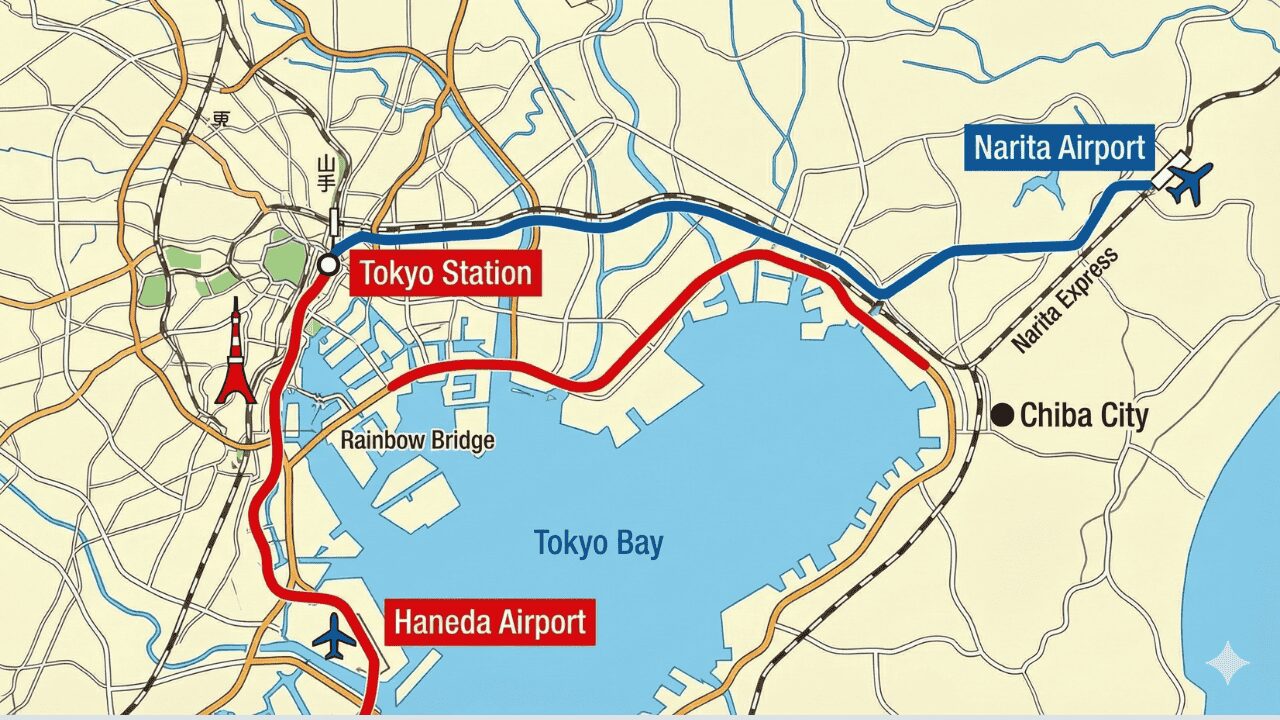
- Haneda (HND): Close to Tokyo. From Tokyo Station, it is generally about around 30 minutes. Less travel stress.
- Narita (NRT): Farther from Tokyo, but strong for international flights. From Tokyo Station, it is as fast as 53 minutes by train, and about 65–70 minutes by bus (varies depending on traffic conditions).
2) Tokyo Station → Haneda Airport (HND) access (recommended order)
The biggest advantage of Haneda is that it is “close.” From Tokyo Station, the main options are trains (with transfers) or buses.
A. Train (JR + Monorail) | Best for simplicity
Route example: Tokyo Station → (JR Yamanote Line / Keihin-Tohoku Line) → Hamamatsucho → (Tokyo Monorail) → Haneda terminals
- Estimated time: About around 30 minutes from Tokyo Station to Haneda (including transfers)
- Features: Plenty of signs and guidance, relatively easy even for first-timers. Not affected by road traffic.
- Note: If you have large luggage, moving inside Tokyo Station and during transfers can be a bit difficult.
B. Train (JR + Keikyu) | Smooth depending on the time of day
Route example: Tokyo Station → (JR) → Shinagawa → (Keikyu) → Haneda terminals
- Haneda is also close from major stations such as Shinagawa (for example, about 15 minutes from Haneda to Shinagawa).
- Note: Keikyu trains have many destinations, so be sure to check the destination display (Terminal / Haneda Airport).
C. Limousine bus | For travelers with lots of luggage (traffic caution)
- Most services depart from and arrive at the Yaesu side of Tokyo Station.
- Merit: Fewer stairs and less walking, making it easier with suitcases or ski bags.
- Demerit: Delays are more likely due to road conditions (especially mornings/evenings, rain, and holidays).
In route/transfer apps, enter the departure point as “Tokyo” and the destination as “Haneda Airport Terminal 1”, “Haneda Airport Terminal 2”, or “Haneda Airport Terminal 3” to search.
3) Tokyo Station → Narita Airport (NRT) access (recommended order)
Because Narita is farther away, the key is choosing between reliability and price.
A. Narita Express (N’EX) | The simplest and most comfortable
- The biggest advantage is direct service from Tokyo Station to Narita Airport.
- Travel time: As fast as 53 minutes (official guidance)
- Seats: Basically reserved seating, and luggage space is easier to secure.
- Example of a discount ticket for foreign visitors: Round trip for 5,000 yen, etc. (conditions apply).
- Note: Since it is based on reserved seating, check schedules and arrange tickets before boarding.
B. Airport bus (TYO-NRT) | Cheap & direct to Tokyo Station (traffic risk)
- Fare: 1,500 yen one-way (official guidance)
- Travel time: About 65 minutes in the fastest display; on the timetable, roughly T3 about 62 min / T2 about 65 min / T1 about 70 min
- Note: The official information states that travel time varies depending on traffic. If your flight timing is tight, allow extra time.
- Late night / early morning: There is guidance that fares may increase depending on the time (e.g., 3,000 yen).
C. Keisei Skyliner | Fast, but requires a transfer from Tokyo Station
- The Skyliner is a limited express that goes toward Ueno and Nippori (not direct to Tokyo Station).
- Speed: Nippori → Narita as fast as 36 minutes, Ueno → Narita about 41 minutes.
- Recommended for: Those staying around Ueno/Asakusa, or those whose base is north of Tokyo Station.
In route/transfer apps, enter the departure point as “Tokyo” and the destination as “Narita Airport Terminal 1” or “Narita Airport Terminal 1” to search.
4) Quick comparison from Tokyo Station (estimated)
| Destination | Method | Estimated travel time | Recommended for |
|---|---|---|---|
| Haneda | JR + Monorail | Around 30 minutes | First-timers who don’t want to get lost, those who want predictable timing |
| Haneda | JR + Keikyu | About 30–45 minutes | Those who find Shinagawa convenient, train-oriented travelers |
| Narita | N’EX | As fast as 53 minutes | Those who want fewer transfers and a comfortable ride |
| Narita | TYO-NRT bus | About 62–70 minutes (varies with traffic) | Those who want a cheaper direct ride to Tokyo Station (with time to spare) |
5) Key cautions (common stumbling points for foreign visitors)
Tokyo Station: the “exit” matters (Yaesu / Marunouchi)
- Many buses and meeting points are on the Yaesu side. If you go to the wrong side, it can add a lot of walking time.
- Tokyo Station is huge, so arriving 15–20 minutes before departure is a safe buffer.
Always confirm the “terminal” at the airport
- Haneda: International flights are mainly T3, and domestic flights are mainly T1/T2 (depends on the airline).
| Terminal | Airlines |
|---|---|
| Terminal 1 | JAL, JTA, SKY, SFJ |
| Terminal 2 | ANA, ADO, SNA, some international flights |
| Terminal 3 | International flights |
- Narita: There are T1/T2/T3, and the bus/train stop also changes (check the official airport access information).
Assume buses may be delayed and build in a “buffer”
- Especially for Narita, delays due to accidents and traffic jams are common. Official information notes that travel time can vary.
- For international flights, there are check-in deadlines, so trains may be a safer option in some cases.
If you have large luggage (ski bags, etc.), choose based on ease of movement
- If you’re worried about stairs and long walks during transfers, buses and the reserved-seat limited express (N’EX) are easier.
6) Which airport should you choose?
- Short stay / mainly sightseeing in central Tokyo / want easier movement: Haneda (HND) is better (closer).
- Cheaper airfare / your international route is only available from Narita / frequent LCC use: Narita (NRT) is realistic, but travel time to Tokyo Station is longer.
-
If you will go directly from Tokyo Station to regional areas (e.g., ski areas) by Shinkansen:
- Arriving at Narita → going directly to Tokyo Station by N’EX is easy to understand
- Arriving at Haneda → closer to Tokyo Station, but transfers are required, so choose based on your luggage
Summary
Haneda and Narita are about 60 km apart, and if you mix them up, it is certain that you will miss your flight. Therefore, we recommend carefully confirming the airport name and checking the route in advance.