Today, major ski resorts across Japan are filled with international visitors. In places like Niseko and Hakuba, it’s not unusual for more than 90% of the guests to be foreigners on certain days. It can be hard to even find Japanese skiers or snowboarders.
I am in my late 30s and grew up in a snowy region, but I only skied once as a child. I started snowboarding in university, but stopped after having children. Last year, I finally returned to the mountains.
For young people in Japan today, winter sports are no longer as popular as they once were. However, Japan used to experience massive ski booms in the past. In this article, I will introduce the history and changes of ski and snowboard culture in Japan.
1. The Beginning of Japan’s Ski Boom (1970s–1980s)
Skiing began to spread widely in Japan from the 1970s through the 1980s. After the period of rapid economic growth, the concept of “leisure” became part of everyday Japanese life.
This era of skiing was characterized by:
- Family vacations
- School events (ski trips)
- Company recreation programs
Skiing became firmly established as a “national winter sport” enjoyed by people of all ages.
2. The Massive Ski Boom of the Bubble Era (Early 1990s)
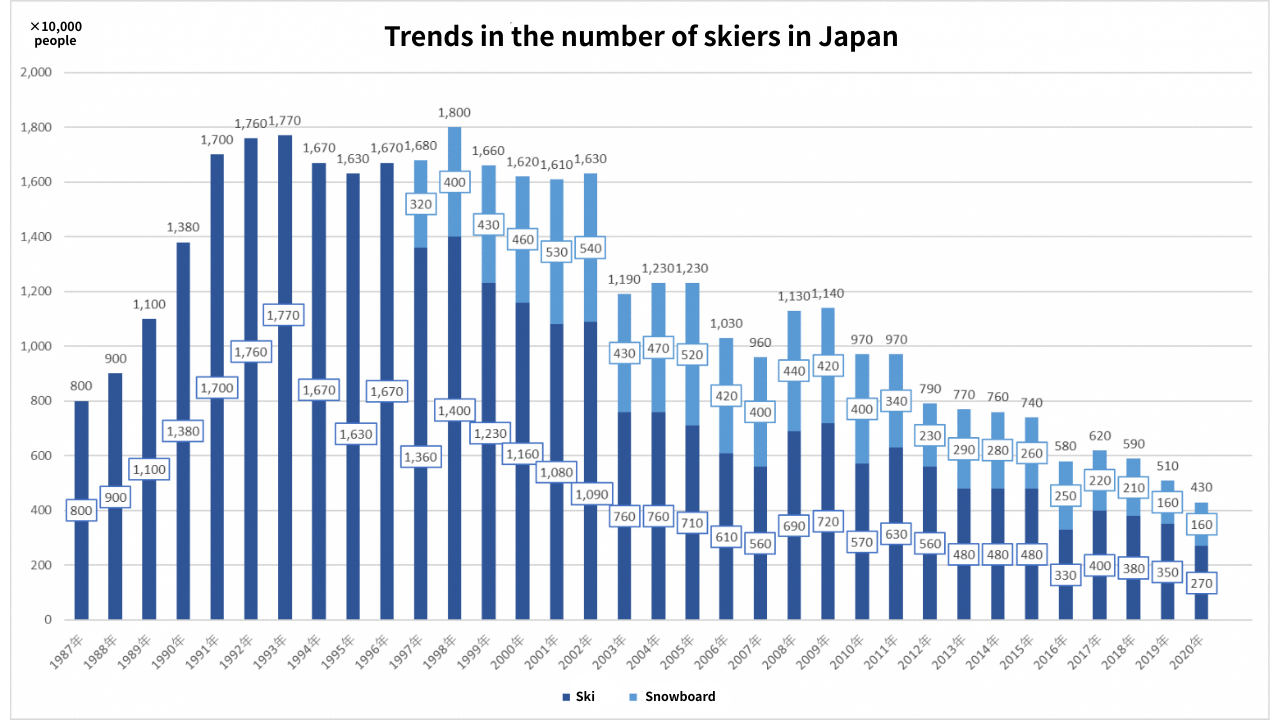
The early 1990s bubble economy marked the peak of Japan’s ski history.
During this period:
- There were over 700 ski resorts nationwide
- Ski resorts became popular dating spots for young people
- Stylish ski fashion was in vogue
- Weekend ski trips by overnight bus or bullet train were common
Movies, TV dramas, and J-pop strongly influenced this culture, and skiing became synonymous with being “trendy.” Large resorts such as Hakuba, Shiga Kogen, and Naeba rapidly developed during this time.
This was the period when Japan’s ski population reached its peak.
3. The Rise of Snowboarding and Youth Culture (Late 1990s)
In the late 1990s, snowboarding spread rapidly throughout Japan. At first, it was seen as dangerous, but it quickly gained explosive popularity among young people.
Key characteristics included:
- A freer and more casual image compared to skiing
- Strong connections with music and fashion
- The birth of park and jump culture
At this time, Japanese ski resorts were full of energy, and “going to the mountains every winter” was a normal lifestyle.
4. The End of the Boom and Decline of Japanese Skiers (2000s)
In the 2000s, Japan’s ski population declined sharply.
Main reasons included:
- Economic stagnation after the bubble burst
- Young people moving away from car ownership and travel
- Diversification of overseas travel and leisure activities
- Aging population and declining birth rate
Many of the more than 700 ski resorts closed, leaving around 500 today.
During this time, the image that “skiing is no longer popular in Japan” became widespread.
5. Skiing Never Completely Disappeared
However, ski and snowboard culture did not vanish entirely.
Instead, several changes occurred:
- A core group of dedicated skiers and snowboarders remained
- Greater focus on powder snow and backcountry riding
- A shift from quantity to quality
Among Japanese riders, more mature styles of enjoyment became common, such as:
- Avoiding crowds and seeking high-quality snow
- Returning to the same mountains every year
6. The Rise of Foreign Skiers and the JAPOW Boom (2010s–)
In the 2010s, Japanese ski resorts experienced a major turning point: a rapid increase in foreign skiers and snowboarders.
The reasons were clear:
- World-class powder snow (JAPOW)
- High-quality lifts and grooming
- Excellent safety and public security
- Food, hot springs, and cultural experiences
Niseko and Hakuba became especially popular with visitors from Australia, North America, and Europe, establishing Japan as a top global powder destination.
7. Is Skiing and Snowboarding Popular Among Japanese Today?
In conclusion, skiing is no longer a nationwide boom like in the 1990s, but it is clearly being re-evaluated and rediscovered.
Recent trends include:
- Young people in their 20s and 30s returning to the mountains
- Powder videos spreading on social media
- Skiing being redefined as a long-term hobby
- Combining skiing with tourism and travel
After the COVID-19 pandemic, more Japanese people began skiing and snowboarding as outdoor activities in nature.
However, opportunities for children to learn skiing and snowboarding have decreased, so fewer people start at a young age. Skiing in particular continues to decline, while snowboarding is more popular among younger generations.
8. Ski Resorts in Japan Today: Shared with the World
Modern Japanese ski resorts are supported by a coexistence of:
- International tourists
- Core Japanese users
English-friendly rentals, ski schools, and restaurants are increasing, making international mountain experiences more accessible to Japanese visitors as well.
Japanese ski resorts are no longer places only for Japanese people. They have become global gathering spots for snow lovers from around the world.
At the same time, resorts are becoming polarized. International-focused resorts like Niseko and Hakuba are crowded and thriving, while local ski resorts used mainly by Japanese continue to lose visitors.
Many local resorts still offer JAPOW of equal quantity and quality. For foreign visitors, these quieter resorts present a rare opportunity to enjoy uncrowded powder. Why not look beyond Niseko and Hakuba and explore Japan’s hidden local ski areas?
Conclusion
Japan’s ski and snowboard culture has gone through:
- A massive boom
- A period of decline
- And a phase of re-evaluation
For Japanese people, skiing has shifted from a temporary trend to a lifelong hobby. For foreigners, Japan offers a special place to experience the world’s best powder.
If you visit Japan’s mountains, it will be more than just a ski trip. It will be a uniquely Japanese snow experience built on decades of history and culture.